
Long before marketers adopted it, journey mapping lived inside software engineering and UX labs.
IT departments used “user journey mapping” as a technical discipline to trace a user’s path through a system: click button A → trigger script B → load database record C. The goal was strictly functional — optimising logic flows, reducing bugs and making sure an interface didn’t crash.
Marketing transformed that cold, linear diagnostic into customer journey mapping (CJM).
From user flows to emotions
The fundamental shift? Customer journey mapping does not just map clicks and steps; it maps human psychology, emotional peaks, hesitation and anxiety. It examines what a person feels, doubts and fears from the moment they realise they have a problem to long after they have swiped their card.
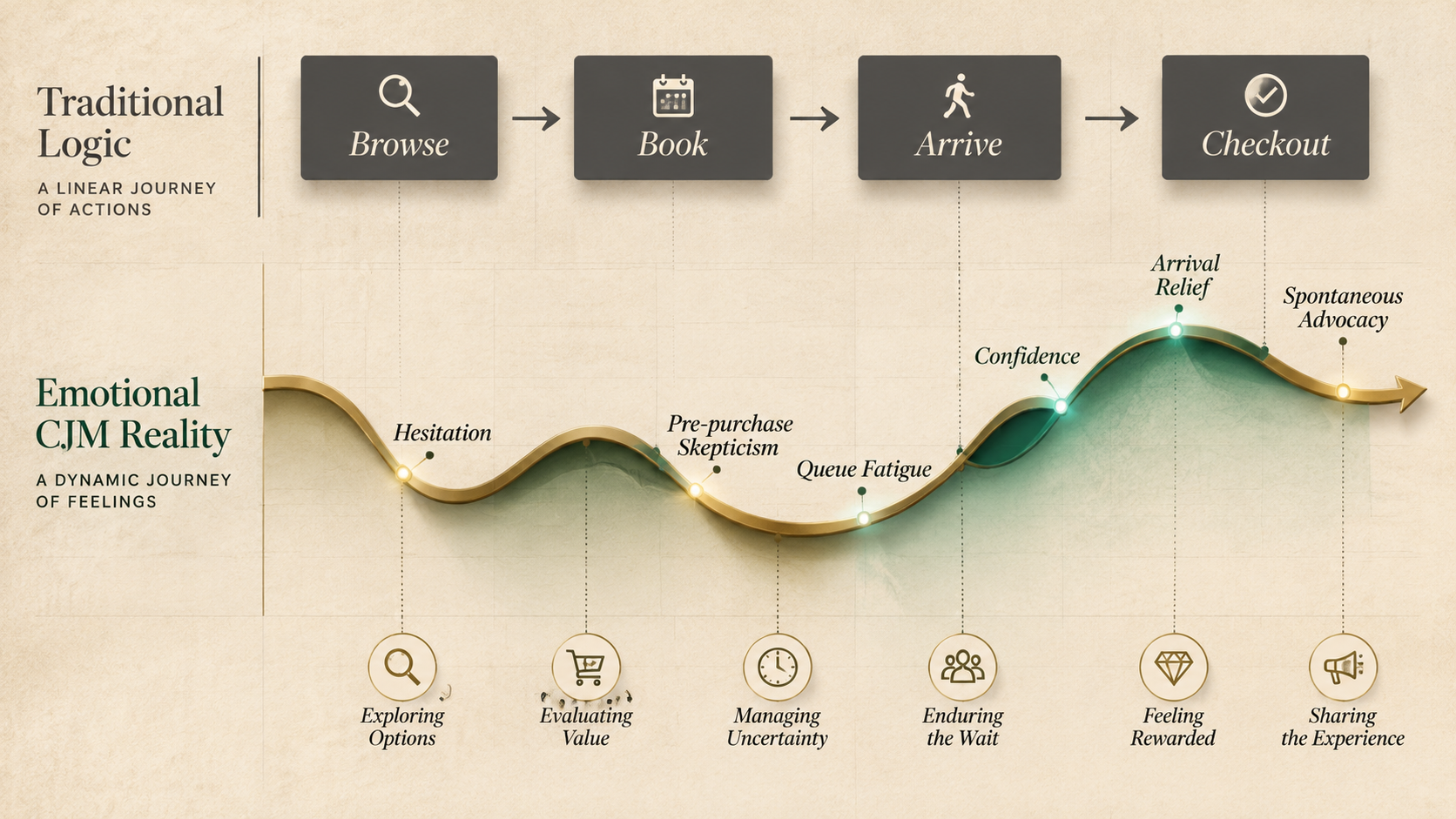
The anatomy of friction: a walk through a hotel booking
To understand how CJM works in the real world, consider someone planning a holiday.
1. Pre-purchase hesitation (anxiety and scepticism)
A customer lands on an independent hotel’s website. Instantly, subconscious questions trigger friction:
- “Is this place legitimate, or are these pictures from 2012?”
- “Will I get stuck in a basement room next to the generator?”
They don’t purchase right away; they look for proof. They scan Google Reviews, compare ratings on booking aggregators and inspect user-uploaded photos. Once their scepticism is neutralised by verified visuals and clear pricing, the emotional needle moves from doubt to confidence. They book.
2. The service delivery bottleneck (fatigue and irritation)
Fast-forward three weeks. The guest arrives after a seven-hour flight, dragging two suitcases, exhausted and desperate for a shower.
Instead of an immediate welcome, they encounter a packed lobby, an understaffed desk and a 25-minute queue. The anticipation built during the booking phase collapses into frustration. Even if the bed is comfortable and the view is spectacular, that initial operational logjam colours the entire stay.
3. The post-experience reaction (advocacy vs churn)
If the experience ends on a sour note, they leave a scathing review warning future travellers about the check-in delays. If the experience was seamless, they become an organic advocate, recommending the hotel to colleagues and leaving a five-star rating.
Closing the loop: turning emotional dips into operational fixes
Average companies treat customer complaints as isolated noise or blame frontline staff. Exceptional companies use their customer journey map as an architectural blueprint for operational fixes.

When a hotel repeatedly maps the check-in stage as an emotional red zone, it doesn’t just put up an apology sign. It redesigns the touchpoint:
- It deploys automated self-service check-in kiosks alongside the traditional reception desk.
- Guests who want a quick key card scan their ID and reach their room in 45 seconds.
- Guests with complex enquiries, or who want personal concierge service, get dedicated attention from staff without feeling rushed.
25 min
Queue at an understaffed desk after a long flight
45 sec
From kiosk to room once the bottleneck is removed
By eliminating the bottleneck, the brand turns an emotional low into a frictionless high.
Why customer journey mapping is indispensable to marketing
In many organisations, marketing is mistakenly treated as top-of-funnel promotion — running ads, writing emails and driving leads. But if marketing promises a five-star luxury experience and the customer encounters a broken operational reality, acquisition dollars are simply burned.
Customer journey mapping bridges the divide between marketing promises and operational delivery in four critical ways.
1. Pinpointing the “silent leaks” in conversion

Marketers often obsess over why a checkout page has an 8% drop-off. Without journey mapping, they try surface-level fixes: changing a button colour or tweaking copy. CJM reveals the psychological barrier — such as an unexpected shipping fee, an unclear returns policy or mandatory account creation — so teams can solve the root hesitation rather than treat the symptom.
2. Aligning marketing with product and customer service
Marketing, sales and customer support often operate in silos. A journey map serves as the single source of truth across all departments. When support agents share recurring customer frustrations, marketing adjusts its messaging to set accurate expectations, and operations updates the product to eliminate the problem.
3. Shifting focus from features to jobs to be done
Customers rarely care about product features in isolation; they care about completing their objective with the least cognitive drag. A detailed map highlights the customer’s true emotional goal at each stage, so marketers can craft messaging that speaks directly to their immediate context rather than listing generic product specifications.
4. Fuelling organic word-of-mouth (zero-CAC growth)
Customer acquisition costs continue to climb across digital channels. The most sustainable antidote to expensive ad spend is high retention and spontaneous referral. When you map and systematically eliminate every friction point across the post-purchase experience, customer satisfaction naturally converts into public reviews, repeat purchases and organic advocacy.
The verdict
A customer journey map is not an artistic diagram to hang in a boardroom; it is an active diagnostic tool.
By tracking where your buyers hesitate, where they experience friction, and how their emotional state changes across every interaction, you gain the clarity needed to fix your product, elevate your service, and turn a fragile sales funnel into a resilient growth engine.
Where are your customers hesitating?
I map the journey from first click to CRM and fix the leaks — inside your own systems.