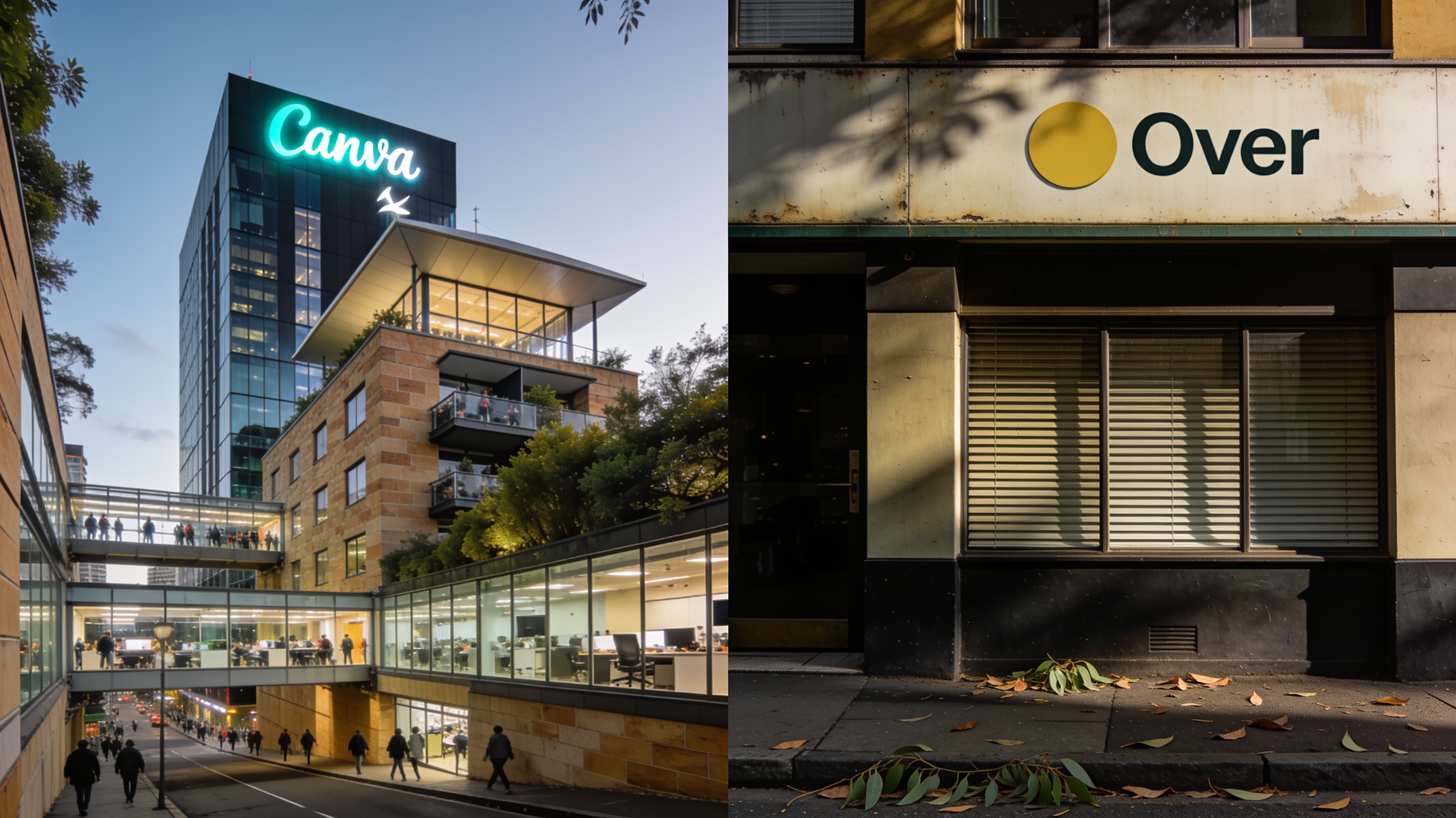
Back in 2016, if you had asked me to compare Canva with an app called Over, the verdict wouldn’t have even been close.
Over was stunning. It had typography that actually looked editorial, gorgeous curated artwork, sophisticated mobile layering tools, and a library of assets that made Canva look like clip art from a 1998 Microsoft Publisher template. I gladly paid an $89 annual subscription without blinking. In terms of craft, visual finesse and mobile usability, Over had won the product war before Canva even got its boots on.
Fast-forward to today.
Canva is an enterprise decacorn worth tens of billions, running inside virtually every corporate marketing department on earth. And Over? Over was acquired by GoDaddy, rebranded as GoDaddy Studio, and now quietly sleeps as an embedded add-on buried inside GoDaddy’s utility dashboard.
The story of how Canva eclipsed a vastly superior competitor is not just a lesson in tech history. It is a cautionary tale for every product builder, agency founder and consultant — and it is the exact reason I refuse to run my own work like Over.
Mistake #1: confining real work to a 6-inch screen

Over fell in love with being the ultimate mobile creative app. But while scrolling on an iPhone on the train is fine for quick Instagram Story captions, serious business collateral does not get built on a phone.
Marketers, operations teams and corporate workers sit in front of dual monitors with ten browser tabs open. They need to drag spreadsheets into charts, copy and paste from docs, and export presentations for 3 pm stakeholder meetings.
Canva understood this immediately. It built a browser-first, zero-install architecture. You didn’t need to download an iOS app or worry about cloud sync between devices — you just opened a Chrome tab, logged in and got to work.
Over treated desktop as an afterthought for years. By the time it realised that professionals live in desktop browsers, Canva had already captured the digital workspace.
Mistake #2: paywalling the gate vs Trojan-horse distribution

Over operated on a classic direct-to-consumer monetisation model: put the best features behind an upfront subscription. If you wanted the goods, you paid the annual fee.
Canva deployed the greatest Trojan horse in B2B history: product-led growth (PLG).
Canva gave away 80% of its utility for free. It allowed anyone — an intern, a social media assistant, an HR coordinator, an executive assistant — to log in and design a banner or a flyer in five minutes without entering a credit card.
Then came the second phase of the trap
- Three people on a team start sharing links to Canva templates.
- Suddenly, twenty people across marketing, HR and sales are using it daily.
- The brand identity starts looking fractured because everyone is using different fonts.
- Canva knocks on the C-suite door: “Half your company already uses Canva every day. Upgrade to Canva for Teams for shared brand kits, team permissions and single sign-on.”
Canva turned employees into an unpaid internal sales force. Over stayed behind an individual $89 mobile paywall, optimising for single-seat transactions while Canva captured enterprise accounts from the inside out.
The graveyard of “superior products”

What happened next was inevitable. Having missed the enterprise wave and desktop dominance, Over sold to GoDaddy in 2020.
When a specialised, beloved creative tool gets absorbed into a domain registrar and web-hosting platform, its independent soul evaporates. It stops setting trends. It gets reduced to a utilitarian feature — a little graphic editor meant to help someone make a quick header for their basic website builder.
The market did not reward the app with the prettier fonts. It rewarded the platform that removed the most friction from the customer’s actual workday.
Over vs Canva at a glance
Why I am not Over
Watching Over disappear into a corporate holding company shaped how I think about business, marketing and my own positioning.
1. Technical perfection means nothing without market fit
You can be the most technically gifted practitioner, have the sharpest aesthetic eye or write the cleanest code. But if your service is delivered in a format that creates friction for the client, you will lose to someone whose initial product was simpler, but far easier to integrate.
2. Don’t trap yourself in a niche channel
Over trapped itself inside an app store. Many professionals do the exact same thing: they become the “Facebook ads person”, the “Figma specialist” or the “one-platform operator”. When user behaviour shifts or the platform changes its rules, their entire value proposition collapses. I build systems directly into client-owned infrastructure — CRM, webhooks, multi-channel pipelines — because longevity requires owning the workflow, not just renting a feature.
3. Focus on the entire job to be done, not the craft
Over was obsessed with graphic design. Canva was obsessed with communication. People didn’t just want to manipulate vector graphics; they wanted to get a presentation approved, send a proposal or launch a social campaign before lunch. When you solve the entire business outcome rather than obsessing over the tool, you become indispensable.
The final verdict
History is full of companies that had the better starting point, the prettier design and the early lead, only to end up as historical footnotes because they refused to evolve where the work actually happens.
Canva didn’t win because it had the best fonts in 2016. It won because it paid attention to where the market was going, removed every barrier to entry, and built a collaborative network that made it impossible to displace.
In business, having a head start is a luxury. Listening to the market and adapting your distribution is survival.
Want marketing built into systems you own?
I build inside client-owned CRMs, webhooks and multi-channel pipelines — so the workflow stays yours, whatever the platforms do next.